The Unseen Language of Modern Design: Why Profession Icons Are More Than Just Graphics
In today’s fast-paced digital landscape, communication must be immediate, clear, and universal. Whether you’re guiding a user through a mobile app interface, crafting an infographic for a annual report, or designing a banner for a career fair, the need for precise visual shorthand is paramount. This is where a dedicated set of Job and Profession Icons becomes not just an asset, but a foundational element of your design toolkit. These icons act as a silent, efficient language, conveying complex roles and industries with simple, elegant forms.
Beyond Decoration: The Functional Role of Profession Icons
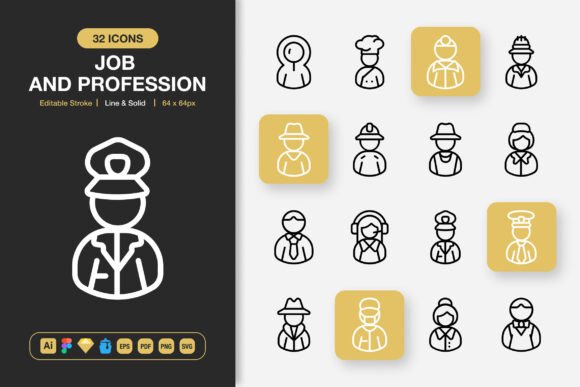
A Job and Profession Icons set is far more than a collection of attractive images. It is a systematic visual library designed to represent various careers, industries, and professional roles. Think of the doctor’s stethoscope, the engineer’s blueprint, the chef’s whisk, or the programmer’s code bracket. When used consistently, these icons create instant recognition, reducing cognitive load for the viewer and streamlining information delivery. They bridge the gap between text-heavy explanations and purely abstract imagery, offering a concrete yet minimalist way to categorize, label, and highlight professional content.
This functionality aligns seamlessly with broader trends in user experience (UX) and information design. As audiences become more visually literate and time-constrained, the demand for intuitive, at-a-glance understanding has skyrocketed. Profession icons meet this demand by serving as navigational beacons in complex websites, as engaging visual elements in social media campaigns targeting specific professional communities, and as clean, recognizable symbols in print materials like flyers and posters for corporate events or educational programs.
Why Minimalist Icon Design is Changing Projects
The call for minimalist icon design reflects a profound shift in aesthetic preferences and practical needs. Cluttered, overly detailed graphics can feel dated and can struggle to scale across different platforms. A minimalist approach—focusing on clean lines, essential shapes, and clear symbolism—ensures versatility and longevity. Icons built with this philosophy remain legible whether they are displayed at 32px on a mobile screen or scaled to 512px for a large-format poster. This adaptability is crucial for creators who work across a multi-platform ecosystem.
Changing your next projects with such a design means embracing efficiency and coherence. For a freelancer designing a client’s website, a unified set of profession icons ensures brand consistency across service pages. For a marketer creating an email campaign for a recruitment drive, these icons can visually segment different job departments quickly. For an entrepreneur developing an app related to networking or education, they provide an immediate visual hierarchy. The minimalist nature ensures the icons support the content without competing with it, allowing the message to remain front and center.
The Integrated Workflow: From Asset to Implementation
The true value of a high-quality icon set is realized in its integration into the creative workflow. A set that offers both Line and Solid Style versions provides creative flexibility, allowing designers to match the icon’s weight to the overall design tone. The feature of an Editable Stroke is particularly powerful, permitting fine-tuning to align with specific brand guidelines or aesthetic nuances without starting from scratch.
Practicality is further cemented by the inclusion of comprehensive, easy-to-use files. The promise of Easy Drag and Drop and support for multiple file formats transforms these icons from static images into dynamic resources. When a set includes the Source File Adobe Illustrator, along with Figma File, Sketch File, EPS Version 10, PDF, and SVG, it respects the diverse tool preferences of today’s design teams. The bundled PNG files in multiple resolutions—from 32px to 512px—eliminate the tedious process of manual scaling, readying icons for immediate use in web, app, and print contexts. This holistic packaging speaks to a changing expectation in the market: professionals now seek assets that are not only high-quality but also workflow-ready, minimizing friction and maximizing productivity.
The Larger Context: Visual Communication in a Professional World
The relevance of a specialized Job and Profession Icons set connects to larger developments in how we conceptualize work and identity. The professional world is increasingly visualized—on LinkedIn profiles, corporate “team” pages, industry conferences, and online learning platforms. A coherent visual language for professions helps standardize this representation, fostering a sense of community and clarity. Furthermore, as remote work and global collaboration expand, these icons become cross-cultural tools, often communicating a role more quickly than text that might require translation.
For the savvy creator or business, investing in such a set is an investment in clear communication. It’s an acknowledgment that in a crowded digital space, the speed and accuracy of your message are competitive advantages. Whether you’re enhancing a website’s UX, elevating a printed brochure’s professionalism, or adding clarity to a complex infographic, these icons serve as the subtle, yet powerful, grammar of your visual story. They are the elements that, when chosen with care and implemented with consistency, make your project not only look polished but also function with intelligent elegance.
Ultimately, a well-crafted set of minimalist profession icons is more than a design resource; it is a strategic tool for anyone looking to communicate effectively with a professional audience. By providing both aesthetic purity and practical depth, it allows designers, marketers, and entrepreneurs to focus on their core message, confident that the visual fundamentals are speaking the right language—clearly, quietly, and effectively.