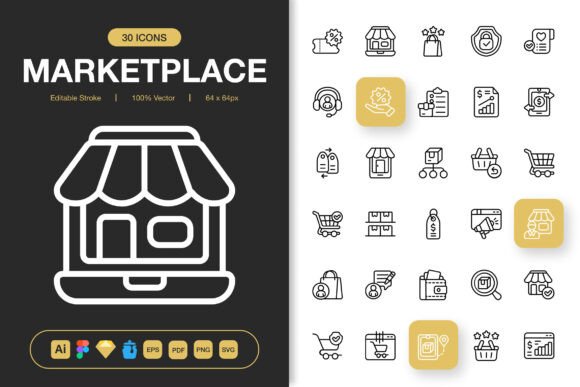
The Strategic Advantage of a Professional Marketplace Icons Set in Modern Design Workflows
In the digital creation space, visual clarity is not just an aesthetic choice; it is a functional necessity. From guiding a user through a mobile app interface to establishing brand recognition on a social media post, icons serve as the silent ambassadors of functionality and intent. For professionals, creators, and entrepreneurs, sourcing these assets is often a critical—and time-consuming—phase in the project lifecycle. This is where a comprehensive set of high-quality icons, like a professional Marketplace Icons pack, transforms from a simple asset purchase into a strategic workflow investment.
Integrating Premium Icons into Your Project Planning Phase
The decision to incorporate a professional icon set is best made at the outset of a project, during the planning and resource gathering stage. Rather than scouring disparate sources for individual icons or attempting to create them from scratch mid-project, acquiring a complete set upfront establishes a foundation of visual consistency. This proactive approach aligns with core principles of efficient workflow management: reducing iterative decision-making, ensuring quality control from the start, and preventing style fragmentation later.
For instance, a small business owner developing a website and accompanying marketing flyers can specify the use of the Marketplace Icons set in their initial style guide. This ensures that the same visual language of "minimalist icon design" appears across the website's navigation, the call-to-action buttons in email banners, and the graphical elements on printed posters. The consistency achieved not only elevates professional presentation but also streamlines the designer's or freelancer's execution process, as they work with a single, cohesive library.
Key Features That Drive Practical Implementation
The utility of an icon set is defined by its technical specifications and how they interact with standard design tools and processes. A set boasting features like an editable stroke and being 100% customizable moves beyond being a static asset to becoming a flexible component. This means a marketer can tweak an icon's line weight to match a bold campaign theme, or an educator can change its color to suit an infographic's palette, all without losing vector integrity.
The inclusion of multiple file formats—Adobe Illustrator, Figma, Sketch, EPS, SVG, and PNG—is a critical factor for seamless integration. This compatibility allows the icons to be dropped directly into the software environment a team is already using. A UI designer working in Figma can utilize the Figma file for rapid prototyping, while a print production specialist can work with the EPS or PDF versions for high-resolution posters. The provided PNG transparency files at specific sizes (32px to 512px) eliminate the need for manual resizing for web and mobile app use, a common time sink in digital projects.
Optimizing Workflows with Drag-and-Drop Organization
A feature like the Iconjar file inclusion speaks directly to workflow efficiency for frequent users. Iconjar is a dedicated icon management application that allows designers to store, search, and drag icons directly into their projects. For a freelancer juggling multiple client projects or an in-house team maintaining a large digital product, this organizational tool prevents asset disorganization. It turns a collection of hundreds of icons into a quickly accessible resource, saving valuable minutes during the execution phase that would otherwise be spent browsing folders.
The workflow benefit extends to collaboration. When a project file (like the Illustrator or Sketch source file) is shared among team members, everyone is working from the same master asset. This prevents version drift and ensures that when an icon is modified by one person for a specific application, that updated version is available to all. It's a simple but effective method for maintaining quality control across distributed teams.
Application Across the Project Spectrum: From Concept to Delivery
The true measure of a resource's value is its applicability throughout a project's lifecycle and across different mediums. A high-quality, minimalist icon set is uniquely versatile. Its use cases naturally align with various project stages and outputs:
- During Initial Concept & Wireframing: Using the SVG or Figma icons in early mockups helps stakeholders visualize functionality and layout without committing to final artwork.
- During Core Development: Developers integrate the PNG assets at specified sizes directly into website or mobile app code, ensuring pixel-perfect rendering on different devices.
- During Marketing Material Creation: The same icons used in the product appear in promotional materials—social media graphics, flyers, and banners—creating a unified brand experience.
- For Long-Term Brand Assets: The editable source files mean the icons can be adapted for future projects, book illustrations, or new infographics, becoming a permanent part of a creator's or business's asset library.
This cross-medium utility underscores the set's role as a multi-purpose tool. It supports the creative process from the initial planning decision, through the active execution phases, and into the future for maintenance and expansion.
Preparing for Integration: Practical Considerations
To smoothly integrate a comprehensive icon set like Marketplace Icons into your routine, a few practical steps can maximize its return. First, upon acquisition, review the Readme.txt file and inventory the provided formats. Match these formats to your current and planned tools—ensure you have the software (Illustrator, Figma, etc.) to utilize the source files. Next, consider implementing an organization system immediately. If using Iconjar, import the set there; if not, create a clearly named folder structure for the different formats (e.g., /vectors, /web_pngs, /print_files) within your project asset directory.
For teams, establish a brief guideline on usage. This might include a note on the preferred default stroke width from the editable files or a convention for which PNG size to use for different contexts (e.g., 64px for mobile app icons, 256px for web hero sections). These minor preparations prevent ad-hoc choices during crunch times and uphold the consistency that a premium set is meant to provide.
The Outcome: Efficiency, Consistency, and Professional Polish
The ultimate outcome of utilizing a well-crafted icon set is tri-fold. Primarily, it introduces significant efficiency into the design and implementation process. Time is not spent creating, searching for, or improperly scaling assets. Secondly, it enforces visual consistency across all project outputs, which is fundamental to professional branding and user experience. Finally, it delivers a level of quality—through high-resolution vector formats and clean minimalist design—that elevates the final product, whether it's a website, an app, or a printed poster.
For the professional, entrepreneur, or creator, these outcomes directly impact project success, client satisfaction, and personal productivity. By treating the acquisition of a high-quality Marketplace Icons set as a strategic step in project planning—a decision that interacts with your tools, your team, and your entire creative workflow—you equip yourself with a resource that pays dividends from the first sketch to the final delivery and beyond.