Onigiri Icons: The Universal Toolkit for Modern Digital Projects
In the crowded landscape of digital design, finding a consistent, high-quality visual language is often a project's first major hurdle. Icons serve as the silent ambassadors of your interface, conveying function, mood, and brand identity in a single glance. The quest for a versatile, reliable icon set that can scale across different mediums ends with a solution like Onigiri Icons. This comprehensive collection isn't just another bundle of graphics; it's a foundational design system built to adapt.
Why Minimalist Icon Design Changes Everything
A minimalist approach to iconography isn't merely a stylistic choice; it's a strategic one. Clean lines, uncluttered forms, and clear symbolism ensure instant comprehension. Users don't pause to decipher a complex illustration; they recognize a simple, well-crafted symbol and act. This efficiency is critical across all touchpoints—from the cramped screen of a mobile app to the expansive layout of a printed banner.
The Onigiri Icons set embodies this principle. By stripping away unnecessary detail, the icons achieve maximum clarity. This makes them perfect not only for websites and apps but also for contexts where information must be absorbed quickly, like infographics, flyers, or social media posts. The minimalist design ensures they never compete with your content; they enhance it.
The Dual Power of Line and Solid Styles
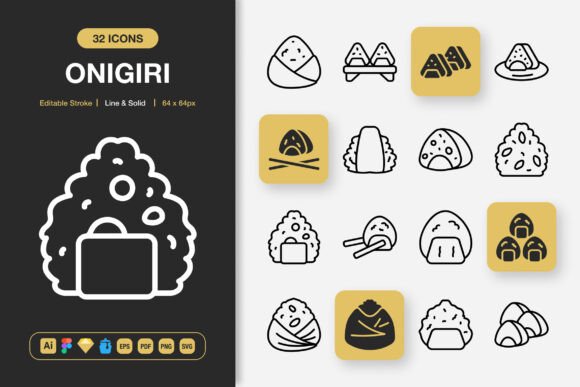
Flexibility is baked into the core of this icon set through the inclusion of both Line and Solid styles. Each style serves a distinct purpose and can dramatically alter the visual weight of your design. The Line style, with its elegant editable strokes, offers a lightweight, modern feel ideal for secondary navigation, subtle annotations, or interfaces requiring a sense of openness.
Conversely, the Solid style provides bold, impactful presence. These icons command attention, making them perfect for primary call-to-action buttons, key feature highlights, or print materials like posters and banners where high contrast is essential. Having both styles within the same cohesive family allows designers to maintain visual consistency while dynamically adjusting emphasis throughout a project.
Beyond the PNG: The Critical Importance of Source Files
Many icon sets promise versatility but deliver only static PNG files at a few sizes. This creates immediate limitations. True adaptability comes from access to the source. The Onigiri Icons package understands this, providing a complete arsenal of editable files that integrate directly into professional workflows.
- Adobe Illustrator and EPS Version 10 files grant vector-level control for print designers, allowing infinite scaling and color separation.
- Figma and Sketch files bring the icons natively into the UI/UX design environment, enabling rapid prototyping and team collaboration.
- The SVG format ensures perfect, scalable rendering on the web, crucial for responsive websites that look sharp on any device.
- Even the Iconjar file is included, streamlining organization and retrieval for designers who manage large asset libraries.
This multi-format approach removes the friction between design and implementation. Whether you're coding a website, laying out a book, or crafting a mobile app, you have the right file format ready for your specific tool.
Scalability Built-In: From 32px to 512px
One of the most practical headaches in digital design is icon resolution. An icon that looks crisp in a footer might become a blurry mess when enlarged for a hero section. Onigiri Icons solves this proactively by including PNG Transparency files at eight essential increments: 32px, 48px, 64px, 96px, 128px, 256px, and 512px. This covers the vast spectrum of use cases—from tiny mobile interface elements to large promotional graphics.
Having these pre-rendered sizes saves countless hours of manual resizing and ensures pixel-perfect quality at every standard dimension. It’s a feature that speaks directly to the needs of developers and marketers who need ready-to-use assets without opening a design software.
Integrating Onigiri Icons Into Your Real-World Projects
How does this collection translate into daily use? Consider a small business launching a new brand. They need a website, a mobile app for loyalty points, social media assets, and physical flyers for a local event. A designer can use the same set of Onigiri Icons across all these channels. The Figma files help wireframe the app and website, the SVGs are handed off to the web developer, the Illustrator files are used to design the flyers, and the 256px PNGs become Instagram post graphics. The brand maintains a unified visual language effortlessly.
For an author creating an eBook, the Line style icons could be used as elegant chapter decorations. A consultancy building a complex client report could use the Solid style icons in their infographics to make data points memorable. The scenarios are endless because the set is built to be universal.
What to Consider Before Choosing Any Icon Set
Selecting an icon set is a commitment. Before integrating any collection into your projects, assess these key factors:
- Style Cohesion: Does the set have a consistent aesthetic that aligns with your brand's tone? The minimalist design of Onigiri Icons offers neutrality and elegance, making it a safe choice for diverse projects.
- Technical Compatibility: Do you have the source files for your primary tools? The provided Illustrator, Figma, Sketch, and SVG files in this package cover most professional scenarios.
- Scalability: Will the icons work at the sizes you need? The range of PNGs and editable vector sources addresses this comprehensively.
- Ease of Use: Is the set organized for efficiency? Features like easy drag-and-drop and the included Iconjar file significantly speed up the design process.
Onigiri Icons is designed to pass these considerations effortlessly. Its 100 customizable icons, while not an infinite library, form a robust core covering common actions, objects, and concepts, reducing the need to mix and match from disparate sets.
Ultimately, a great icon set acts as a silent partner. It doesn't dictate your design but empowers it. By offering high quality across both line and solid styles, unparalleled format versatility, and ready-to-use scalability, Onigiri Icons moves from being a simple asset purchase to becoming a long-term design resource. It fits into the modern workflow where a project might start on Figma, move to development with SVG, and branch out into print with EPS—all without the designer ever needing to search for a different icon. That seamless adaptability is what changes your next project, and all the ones that follow.