The Monument Landmark Icons Design Resource
In digital and print design, the need for clear, recognizable visual symbols is constant. Icon sets serve as foundational tools, and a specialized collection like Monument Landmark Icons offers a focused solution. This article examines this set of high-quality icons, exploring its characteristics, potential applications, and key considerations for designers evaluating such resources.
Understanding the Monument Landmark Icons Collection
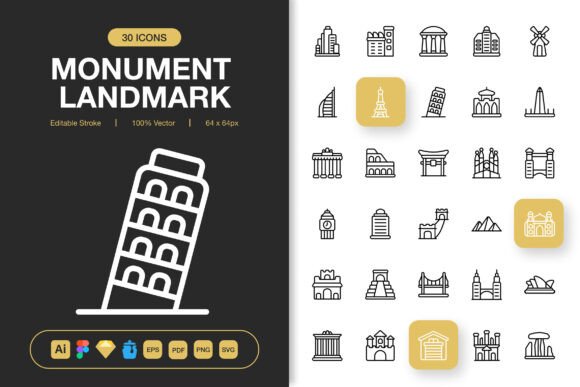
Monument Landmark Icons is a curated set of vector icons depicting famous architectural landmarks and monuments. The design approach is minimalist, focusing on clean lines and simplified forms that capture the essence of each structure. The set is described as suitable for diverse projects, including websites, mobile applications, print materials like books and posters, and digital content such as social media graphics and infographics.
The technical offering is comprehensive. Files are provided in multiple formats essential for professional workflow: Adobe Illustrator source files, Figma, Sketch, IconJar, EPS, PDF, and SVG for scalability, alongside PNG files at specific pixel dimensions for immediate use. The inclusion of editable stroke paths in the vector files underscores its customizable nature, allowing designers to adjust weight, color, and detail to fit a project's specific aesthetic.
Reasons for Interest and Potential Benefits
Designers and content creators might consider this icon set for several practical reasons. First, it provides a cohesive visual library for projects requiring thematic consistency around travel, geography, history, education, or culture. Instead of sourcing individual icons from disparate places, a unified set ensures stylistic harmony.
The primary benefit is efficiency. The ready-made, high-quality assets reduce the time spent creating custom illustrations from scratch. The easy drag-and-drop capability and multiple file formats aim to integrate smoothly into various design environments. Furthermore, the scalability of vector formats means one icon can be adapted for a mobile app button or a large poster without loss of quality.
The minimalist design philosophy is a significant feature. Clean icons often enhance usability by being quickly comprehensible and tend to align with modern design trends that favor simplicity and clarity over ornate detail. This can make the icons versatile across different media and audience contexts.
Trade-offs and Considerations
While specialized sets offer focus, a potential trade-off is scope. Monument Landmark Icons is inherently niche. If a project requires a broad range of symbols beyond landmarks—such as UI actions, common objects, or business concepts—this set alone would be insufficient. Complementing it with a more general icon library might be necessary.
The expectation of "100 customizable" icons implies a degree of flexibility, but customization still requires working within the existing vector paths. Major structural alterations to an icon's form may be challenging. Designers should assess whether the minimalist representation of specific landmarks meets their need for recognizability; some audiences might prefer more detailed or photorealistic imagery.
Another consideration is the balance between uniqueness and universality. While these icons are tailored, some very common landmark silhouettes might be available elsewhere for free or lower cost. Evaluating the specific selection list and the quality of execution against project budget and time constraints is a practical step.
Situations Where This Set Is a Strong Fit
This icon collection is particularly well-suited for projects with a clear thematic anchor to global locations, heritage, or tourism. Examples include a travel booking website, an educational app about world history, a museum's visitor guide pamphlet, or a conference poster for an international event. In these cases, the icons serve as immediate visual cues that reinforce the content's subject matter.
Projects demanding a consistent modern aesthetic across multiple touchpoints also benefit. A campaign using website banners, social media posts, and printed flyers can employ the same icon set at different scales, maintaining a professional and unified brand presentation. The availability of specific PNG sizes simplifies direct implementation for digital platforms.
For design teams working with established software like Illustrator, Figma, or Sketch, the inclusion of native source files facilitates seamless integration into their existing workflow, allowing for efficient editing and adaptation.
When Alternatives Might Be Worth Considering
If a project's scope is generic or requires a wide variety of icon types—interface controls, file type symbols, industry-specific tools—a more comprehensive, general-purpose icon pack would be a better starting point. Many such sets offer thousands of icons covering numerous categories.
Budget limitations might lead designers to explore free or open-source alternatives. Some vector repositories offer landmark icons, though they may lack the cohesive style or file format breadth of a commercial set. The trade-off involves time spent searching, curating, and potentially standardizing disparate assets.
For projects where brand identity requires utterly unique iconography, custom illustration, even for a limited set of landmarks, might be the preferred path. This ensures total creative control and alignment with a brand's specific visual language, though at a significantly higher cost and time investment.
Practical Decision-Making Insights
To determine if Monument Landmark Icons aligns with your needs, start by auditing your project's actual icon requirements. List the specific landmarks or monument symbols you need and check them against the set's contents. Verify the file formats match your team's software ecosystem; for instance, Figma file inclusion is crucial for teams using that platform predominantly.
Consider the longevity of the asset. Will these icons be useful for future projects? Investing in a quality set can build a personal or organizational design resource library. Evaluate the balance between the specialized focus and your likely future needs.
Finally, review the editable nature of the files. If your project requires subtle adjustments to color schemes or line weights to match existing brand guidelines, the customizable vector strokes are a key advantage. If you only need static PNGs at fixed sizes, the value proposition might differ.
Conclusion: Aligning Resources with Goals
Monument Landmark Icons represents a targeted solution for a specific design need. Its value lies in its cohesive minimalist style, high-quality vector construction, and provision of multiple professional file formats. For projects centered on location, culture, or travel, it can enhance visual communication and save production time.
However, its niche focus means it is not a universal toolkit. Designers should weigh its thematic suitability against project scope, budget, and the need for stylistic uniqueness. By carefully matching the attributes of this resource—or any specialized icon set—to the concrete demands of the work, designers can make informed choices that effectively support their creative and practical goals.