The Modern Toolkit: Adventure Icons and Minimalist Design in Digital Projects
In the ever-evolving landscape of digital creation, the visual language we employ is fundamental. Elements like icons serve not merely as decoration but as critical navigational aids, functional indicators, and brand ambassadors. Their design philosophy can dramatically alter user perception and project efficacy. The interplay between detailed, thematic sets like Adventure Icons and the clean efficiency of minimalist icon design represents a pivotal choice for creators across disciplines.
From Specific Themes to Universal Application
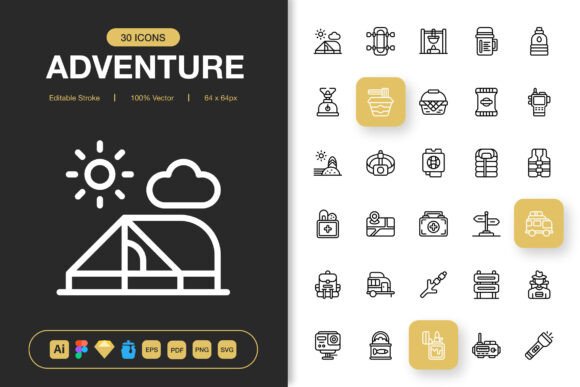
The concept of a dedicated icon set, such as Adventure Icons, provides a powerful starting point for projects with a clear narrative or aesthetic direction. These sets are curated collections where each symbol—a mountain peak, a compass, a kayak—carries inherent meaning and evokes a specific atmosphere. They are high-quality assets crafted for cohesion, ensuring that every visual element supports a unified story. This thematic strength is invaluable for projects targeting a particular feel, such as travel apps, outdoor brand websites, or educational materials about exploration.
However, the true versatility of such a set lies in its technical construction. When these icons are built with features like editable strokes and provided in multiple source formats—Adobe Illustrator, Figma, Sketch, EPS—they transcend their initial theme. A designer can adjust the color of a tent icon from earthy green to corporate blue, simplify its line weight, and repurpose it for a corporate sustainability report. The adventure becomes a metaphor for innovation. This customizable nature, supported by easy drag-and-drop files and comprehensive sizes from 32px to 512px, means a well-crafted thematic set can seed ideas far beyond its original domain.
The Transformative Shift to Minimalist Essentials
Following the use of a rich, thematic set, many creators encounter a need for clarity and scalability. This is where the conscious shift to minimalist icon design reshapes ongoing projects. Minimalism in iconography is not about subtraction for the sake of style; it is a principle focused on maximum communication with minimal visual noise. These icons reduce forms to their essential geometry, prioritize consistent line weights, and often embrace a monochromatic or limited color palette.
The advantages of this approach are profound for usability and integration. A minimalist icon set functions as a versatile toolkit, perfect for interfaces where information density is high, such as mobile apps or complex web dashboards. Their simplicity ensures quick recognition across cultures and age groups, reduces cognitive load for users, and maintains visual integrity when displayed on diverse screens—from a smartphone notification to a large conference banner. Furthermore, their clean forms blend seamlessly with text and other graphic elements, preventing the visual competition that more detailed icons might introduce.
Real-World Applications Across Creative Fields
The practical journey from thematic to minimalist, or the selective combination of both, is evident in numerous professional fields.
- Web & Mobile Development: A developer might use Adventure Icons for a hero section on a landing page to establish brand character, then switch to minimalist icons for the navigation menu and settings panel to ensure fast, unambiguous interaction.
- Print & Editorial Design: An infographic about global hiking trails could incorporate detailed adventure symbols as key visual anchors. The accompanying book's glossary, however, might use minimalist variations of those same icons for clear, print-friendly reference markers.
- Marketing & Social Media: A campaign poster might employ the full-color, detailed PNG versions of adventure icons for emotional impact. The social media avatar and recurring campaign hashtag visual, needing to be identifiable at tiny sizes, would leverage the scalable SVG versions adapted with minimalist traits.
- Education & Research: Interactive learning modules on geography can use themed icons to engage students. The analytical data dashboard for the research team tracking engagement metrics would benefit from minimalist icons to present data clearly without distraction.
The inclusion of files like IconJar, SVG, and PNG with transparency in multiple resolutions is what makes this adaptive workflow possible. It allows a hobbyist creating a flyer for a community camping trip and a business owner designing a investor presentation to use the same core assets with radically different outputs.
Considerations for Implementation and Selection
Choosing and implementing icon sets requires thoughtful evaluation beyond mere aesthetics. First, consider the technical compatibility. Does the set provide the source file formats—AI, Figma, Sketch—that match your primary design software? The ability to edit the source is crucial for both adapting thematic icons and enforcing minimalist standards across a project.
Second, assess scalability. The provision of PNG files at specific pixel dimensions (32px, 48px, 64px, etc.) is a sign of practical forethought, ensuring icons remain sharp for specific platform requirements. However, the vector files (SVG, EPS, PDF) are key for true scalability and future modifications, allowing an icon to shine on a retina display or be enlarged for a mural print.
Finally, balance thematic resonance with functional clarity. A set like Adventure Icons offers immediate narrative power. The subsequent or integrated use of minimalist design principles ensures that this power does not become a barrier to understanding. The goal is always to enhance communication: whether evoking the spirit of an adventure or enabling the efficient completion of a task.
The Enduring Impact of Intentional Iconography
Visual assets are the silent workforce of any project. Their quality, format, and design philosophy directly influence user experience, brand perception, and creator workflow. A high-quality, customizable set with comprehensive file support serves as a robust foundation. From this foundation, the move towards minimalist icon design can refine and elevate projects, ensuring they are not only visually appealing but also universally accessible and functionally superior.
This evolution from specific to universal, from detailed to essential, mirrors the broader journey of digital design. It underscores that the best tools are those that empower adaptation, encourage clarity, and support the creator's vision from initial concept to final deployment across the myriad touchpoints of our digital world—from websites and apps to books, posters, and beyond.