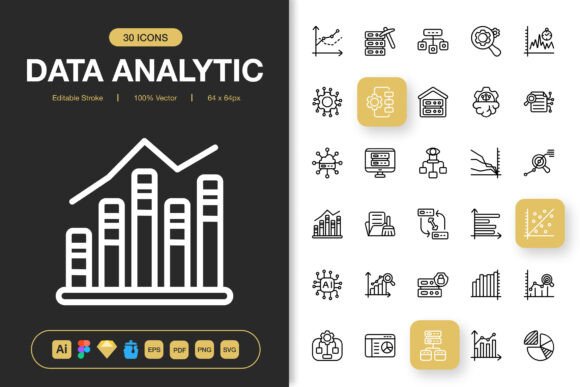
Minimalist Data Analytic Icons for Modern Design Projects
Visual communication is a cornerstone of effective design, and icons are one of its most powerful tools. A well-crafted set of icons can transform a complex idea into an instantly recognizable symbol, guiding users and enhancing comprehension. For fields like data analytics, where concepts like charts, metrics, and processes are central, having a dedicated, high-quality icon set is invaluable. This is where a specialized Data Analytic Icons collection becomes a game-changer for creators across industries.
Why Data Visualization Needs Specialized Icons
Generic icons often fall short when you're trying to convey specific data-centric actions or concepts. Imagine trying to represent a "correlation analysis" or a "real-time data feed" with a standard gear or house icon—it simply doesn’t work. A dedicated set of Data Analytic Icons fills this gap. These icons are designed with a minimalist aesthetic, stripping away unnecessary detail to focus on the pure shape and meaning of data-related functions. This clarity is crucial not only for aesthetic cohesion but for user understanding. In a dashboard or an app, a user should immediately grasp that an icon represents "export data," "filter dataset," or "trend prediction" without reading a label.
The strength of a focused set lies in its consistency. Every icon shares the same design philosophy—line weight, stroke style, and visual proportion. This creates a harmonious visual language that makes your entire project, whether it's a website, mobile application, or printed report, look professionally crafted and thoughtfully planned. It signals to your audience that you pay attention to detail.
Core Characteristics of a High-Quality Icon Set
When evaluating an icon set, several practical qualities stand out. First is editability. Icons with editable strokes are not static images; they are design assets. You can adjust the line thickness, change colors, or even modify elements to better fit your brand palette without degrading quality. This flexibility is essential for customization.
Next is the breadth of file formats included. A truly useful package provides the source files—like Adobe Illustrator—for deep editing, alongside ready-to-use formats for various platforms. Having Figma, Sketch, SVG, and EPS files means designers, developers, and marketers can all work with the icons in their preferred environment. The inclusion of multiple PNG sizes (from 32px for mobile interfaces to 512px for large presentations) ensures they are resolution-ready for any screen or print medium.
Finally, the method of access matters. Features like easy drag-and-drop and organized files (such as an IconJar library) streamline the workflow. Instead of hunting through folders, you can quickly browse and place icons, significantly speeding up the design process. This focus on usability directly translates to saved time and reduced frustration.
Transforming Projects Across Multiple Environments
The application of a minimalist Data Analytic Icons set is remarkably broad. Their clean style ensures they don't clash with existing design elements, making them suitable for integration into almost any context.
For digital products, such as SaaS dashboards, financial apps, or business intelligence tools, these icons enhance the user interface. They make navigation intuitive and information architecture clear. A user encountering a familiar, well-designed icon for "data merge" or "statistical model" will feel more confident using the software.
In marketing and communication, these icons become powerful visual aids. Use them in social media graphics to highlight key metrics in a post. Incorporate them into infographics, flyers, or banners to break down complex data stories into digestible visual points. They add a layer of professional polish to posters and print materials that generic clip art cannot provide.
Educational and publishing contexts also benefit greatly. Textbook authors, online course creators, and bloggers can use these icons to illustrate chapters on data science, visualize tutorials, or create clearer instructional diagrams. The minimalist design avoids visual clutter, keeping the learner's focus on the content itself.
Even for internal business projects—like creating a streamlined process flowchart for a team, or designing a presentation for stakeholders—these icons lend credibility and clarity. They help communicate procedures and results more effectively than text alone.
Practical Benefits Beyond Aesthetics
Choosing a comprehensive icon set like this isn't just about making things look better. It's a practical decision that impacts workflow and outcomes. Efficiency is a major gain. With 100 customizable icons at your disposal in multiple formats, you eliminate the time spent searching for disparate icons across different websites or attempting to create them yourself from scratch.
Brand consistency is another critical advantage. Using the same family of icons across all your touchpoints—your website, app, PDF reports, and promotional emails—creates a strong, unified brand identity. It makes your communications instantly recognizable.
From a user experience (UX) perspective, good icons reduce cognitive load. Users decode interfaces faster, navigate more smoothly, and find information more easily. This leads to higher engagement, lower bounce rates, and better overall productivity for the end-user, which is the ultimate goal of any data-driven platform.
Selecting and Implementing Your Icon Assets
When you decide to integrate a new icon set into your projects, a few considerations can ensure a smooth process. First, audit your needs. Look at your current projects and identify the specific data operations or concepts you need to visualize. Does the set cover your requirements? With 100 icons, a comprehensive Data Analytic Icons collection likely covers the vast majority of common and advanced data functions.
Secondly, test the editability. Before full implementation, open the source file in Illustrator or Figma and try adjusting an icon's color or stroke. This confirms the flexibility you'll have for future adaptations. Check that the SVG files are clean and well-structured for web use, as this format is essential for scalability and performance on websites.
Finally, organize your workflow. Use the provided IconJar or similar library file to import the set into your design system. Establish a naming convention or a folder structure for the PNG sizes to avoid confusion later. The included Readme file is often a helpful starting point. By treating these icons as a core part of your asset library from day one, you maximize their value and ensure they are used consistently.
In a world where data is central, the way we visualize it matters. A minimalist, high-quality, and fully customizable set of Data Analytic Icons is more than a collection of images; it's a professional toolkit. It empowers you to communicate more clearly, design more efficiently, and build a more cohesive visual identity across every project, from a simple flyer to a complex interactive dashboard. The right icons don't just decorate your work—they elevate its meaning and functionality.