The Evolution of Visual Communication: Why High-Quality Icon Sets Like Natural Disaster Icons Are Essential
In today's digitally saturated environment, clarity and speed of communication are paramount. Every pixel, every symbol, carries weight. For professionals, creators, entrepreneurs, and marketers, the challenge is not just to convey information, but to do so with immediate comprehension and aesthetic coherence. This is where the strategic use of premium icon sets becomes a critical component of successful projects. A set like the Natural Disaster Icons exemplifies this shift: it is not merely a collection of images, but a versatile toolkit designed to meet the sophisticated demands of modern visual storytelling.
Beyond Decoration: Icons as Functional Narrative Tools
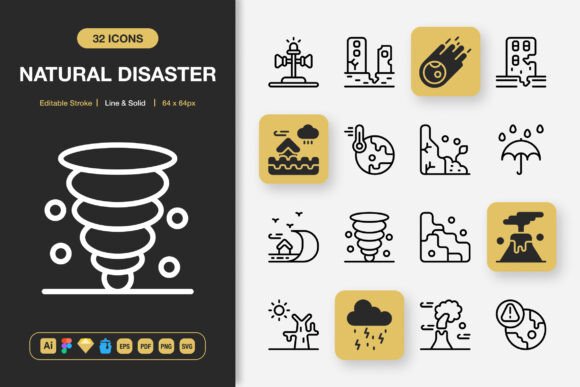
Icons have transcended their role as simple interface elements or decorative flourishes. They are now integral to building narrative, establishing tone, and guiding user attention across diverse media. The Natural Disaster Icons set, for instance, serves a specific but universally understood thematic need. Whether used in an emergency preparedness mobile app, a climate research infographic, a news website banner, or a community safety poster, these icons deliver a complex concept—like a hurricane, earthquake, or wildfire—in an instant. This efficiency is invaluable. It aligns with a broader trend across industries: the move towards minimalist design that reduces cognitive load while maximizing impact.
Meeting the Demands of a Multi-Platform Creative Workflow
The contemporary creator’s workflow is rarely linear or confined to one software. A project might begin in Figma for prototyping, move into Adobe Illustrator for detailed asset creation, be implemented in a web project via SVG, and finally be output for print as a PDF. A fragmented asset set that only works in one environment creates friction and delays. The comprehensive file suite included with the Natural Disaster Icons—covering Illustrator, Figma, Sketch, IconJar, EPS, SVG, PNG, and more—directly addresses this need for seamless interoperability. This isn't just a convenience; it's a response to the hybrid, agile workflows that define professional creative and development processes today.
The inclusion of multiple PNG sizes (from 32px to 512px) speaks to the context-aware nature of modern design. An icon must perform flawlessly on a smartphone screen, a desktop dashboard, a large-format poster, and within a social media flyer. Each context requires a different resolution and level of detail. By providing these pre-optimized variants, the set empowers users to deploy icons rapidly without manual resizing or quality degradation, maintaining visual integrity across every touchpoint.
The Strategic Advantage of Editable and Customizable Assets
Forward-looking design resources understand that adaptation is key. A static, unchangeable icon might fit one project but clash with the brand palette or style guide of the next. The editable stroke and fully customizable nature of the Natural Disaster Icons provide a crucial strategic advantage. A marketer can tweak the line weight to match their company’s sleek website aesthetic; a book designer can adjust the color to complement their chapter’s theme; a freelancer creating a client’s infographic can switch from the line style to the solid style to achieve better visual hierarchy.
This adaptability connects to larger developments in the technology and business sphere. The rise of brand personalization and the need for consistent visual language across all consumer-facing materials mean that off-the-shelf assets must be malleable. They must serve as a foundation, not a final product. The ability to easily drag, drop, and then refine these icons allows professionals to maintain brand coherence without starting from scratch for every new campaign or application, saving significant time and resources.
Quality as a Non-Negotiable Standard
The term "high quality" in the descriptor of the Natural Disaster Icons set is not a vague boast. In practical terms, it means clean vector paths that scale infinitely without distortion, thoughtfully crafted silhouettes that remain recognizable at small sizes, and a cohesive design language across all 100 icons. This level of quality is what separates a professional resource from an amateur collection. For entrepreneurs and enthusiasts launching a website or app, the visual polish conveyed by such icons contributes directly to perceived credibility and user trust. In a competitive market, the details matter.
Observations from leading digital products show that users associate intuitive, well-designed iconography with overall product reliability. When an icon set is both thematically specific—like covering the range of natural disasters—and executionally superb, it enables designers to build interfaces and communications that are not only functional but also authoritative and clear.
Why Minimalist Icon Design Is Changing Projects
The shift towards minimalist icon design is a reflection of evolving user preferences and expectations. Audiences are overwhelmed with visual information. A clean, uncluttered symbol cuts through the noise. The Natural Disaster Icons set, with its focused theme and clean execution, is perfectly suited for this environment. Minimalism here is not about reduction for the sake of style; it’s about enhancing functionality. A simple, bold icon for a "tsunami" on an emergency alert banner communicates faster and more effectively than a detailed, realistic illustration.
This trend extends beyond web and mobile. Print materials like flyers and posters benefit immensely from minimalist icons. They ensure legibility from a distance and improve the overall layout’s balance. For social media graphics, where space is limited and attention spans are short, a powerful, minimal icon can become the central anchor of the message, driving engagement and comprehension.
Connecting to Larger Developments: The Universal Language of Symbols
The relevance of a high-quality, thematic icon set like Natural Disaster Icons ties into the global move towards universal, accessible design. As our projects and communications reach broader, more diverse audiences, the reliance on text-heavy explanations becomes a barrier. Well-designed icons function as a near-universal language. They can make critical information about safety, science, or services accessible across language and literacy levels. This is particularly poignant for a set focused on natural disasters, where clear communication can have real-world implications.
From a business and technology perspective, this aligns with the push for more inclusive and user-friendly digital products. Incorporating a robust set of icons is a step towards creating experiences that are easier to navigate and understand for all users. It’s a practical investment in usability and accessibility, which are no longer niche considerations but central pillars of successful project development in any field.
Conclusion: Integrating Purpose-Driven Tools into Your Creative Process
The decision to incorporate a professional icon set such as the Natural Disaster Icons into your next project is more than a mere asset purchase. It is an integration of a purpose-driven tool into your creative or business process. It addresses the need for speed, adaptability, cross-platform consistency, and aesthetic minimalism that defines current best practices. By providing a ready-made, yet fully customizable, visual vocabulary for a specific and important theme, it allows professionals to focus on their core narrative or functionality, rather than on the painstaking creation of basic graphical elements.
As visual communication continues to evolve, the tools we choose must be as insightful and practical as the content we create. A comprehensive, high-quality set that includes source files, multiple formats, and scalable sizes—like the Natural Disaster Icons described—empowers you to meet those evolving standards head-on, ensuring your websites, apps, books, campaigns, and print materials communicate with the clarity and impact that today’s audiences expect and deserve.