Evaluating the Joint Pain Icons Set for Your Projects
The search for high-quality, versatile iconography is a common task for designers, developers, and content creators across many fields. Among the numerous options available, specialized sets like the Joint Pain Icons offer a focused solution. This article provides an objective evaluation of such an icon set, exploring its potential fit for various projects to aid in your decision-making process.
What Is the Joint Pain Icons Set?
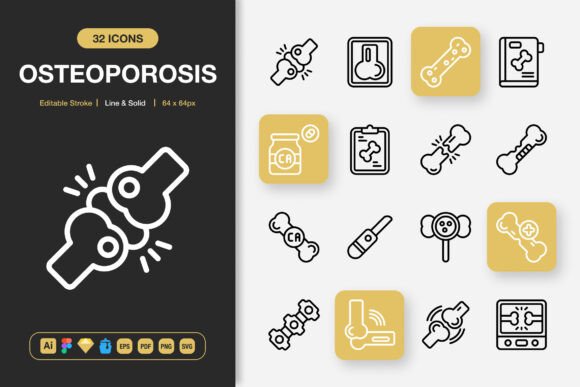
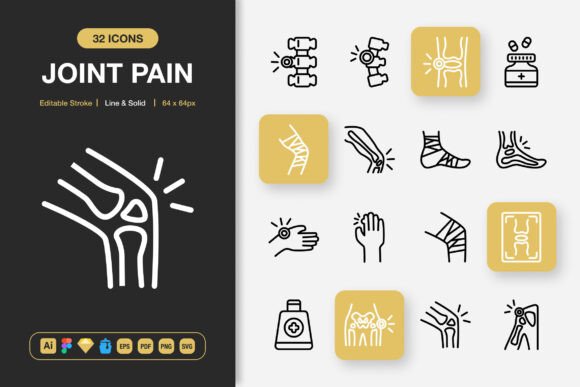
The Joint Pain Icons set is a curated collection of digital icons specifically designed to illustrate concepts related to joint pain, anatomy, treatment, and related health topics. As described, it is a set of high-quality icons suitable for any project. The package emphasizes minimalist icon design and promises to enhance projects across a wide range of media, from digital applications like websites and mobile apps to print materials such as flyers, books, and posters.
The technical offering is comprehensive. The set includes icons in both Line and Solid styles with an editable stroke, allowing for customization of weight and appearance. It boasts 100 customizable icons provided in multiple file formats to ensure compatibility with standard design workflows. These formats include source files like Adobe Illustrator (.ai), Figma, Sketch, and IconJar, alongside export-ready versions such as EPS, PDF, SVG, and PNG files in multiple resolutions (from 32px to 512px). The inclusion of a readme file typically aids in setup and usage.
Reasons for Interest and Key Benefits
Interest in a specialized icon set like Joint Pain Icons generally stems from a need for cohesive, professional visual communication within a specific niche. The primary benefits are consistency, efficiency, and quality.
- Project Consistency: Using a unified set ensures all iconography shares a common aesthetic—minimalist design in this case—which creates a polished, professional look.
- Workflow Efficiency: The easy drag-and-drop functionality and the provision of files for major design platforms (Illustrator, Figma, Sketch) can significantly speed up the design process compared to sourcing or creating individual icons.
- Quality Assurance: The promise of high-quality, vector-based files (SVG, EPS, Illustrator) means icons are scalable without loss of detail, crucial for both print and high-resolution screens.
- Adaptability: Customizable strokes and the availability of two styles (Line and Solid) offer flexibility to match different brand guidelines or visual contexts within a project.
Tradeoffs and Considerations
While the benefits are clear, a balanced evaluation requires considering potential tradeoffs.
The foremost consideration is scope. The Joint Pain Icons set is, by its name and description, specialized. Its 100 icons are focused on a specific medical/health theme. This is a significant advantage for projects directly within that niche but a limitation for general-purpose projects needing a broader range of subjects. A designer working on a comprehensive health app might find it perfect for the joint care section but need another set for nutrition or mental health modules.
Another practical consideration is format relevance. While the array of included files is impressive, your specific workflow may only require one or two. If you exclusively use Figma, the Illustrator and Sketch files are less directly useful, though having source vectors is still valuable. Conversely, if you work in a platform not listed, you must rely on the generic SVG or PNG files, which might require additional conversion steps.
The minimalist design style itself is a tradeoff. Minimalism excels in clarity and modern appeal, but it may not convey the detailed realism or emotional warmth required for certain types of patient-facing materials. It is important to assess whether the visual tone aligns with your project's goals.
Situations Where This Set Is a Strong Fit
The Joint Pain Icons set is likely an excellent choice in several specific scenarios.
- Health Education and Medical Content: Creating websites, mobile apps, infographics, or printed materials focused on arthritis, orthopedic health, physical therapy, or senior care.
- Specialized Digital Products: Developing a feature or module within a larger health application that specifically addresses joint pain or anatomy.
- Professional Presentations and Banners: Designing materials for medical conferences, clinic posters, or patient information flyers where clear, schematic visuals of joints are needed.
- Cross-Media Projects: Undertaking a campaign that requires identical icons for both digital (social media, websites) and print (books, flyers) outputs, benefiting from the multi-format and multi-resolution PNG files.
- Teams Seeking Design Alignment: Design teams needing a single, reliable asset source to ensure all members produce visually consistent icons without individual drawing skills.
When to Consider Alternatives
Alternatives may be worth exploring if your project parameters differ.
- Broad-Subject Projects: If your project covers general healthcare or wellness broadly, a more comprehensive medical icon pack with a wider range of subjects (e.g., including organs, medications, general fitness) might be more efficient than combining several niche sets.
- Budget and Scale Constraints: For a very small, one-time project needing only a few joint-related icons, using a free or subscription-based icon library with a searchable database might be more cost-effective than purchasing a dedicated set.
- Specific Style Requirements: If your brand or project demands a non-minimalist style—such as detailed illustrative, hand-drawn, or highly colorful iconography—this set's design approach may not be suitable.
- Technical Platform Limitations: If your primary design tool is not among the provided source file formats (e.g., Affinity Designer or Canva), and you lack the ability to easily convert vector files, you might prioritize sets that offer direct compatibility.
Practical Decision-Making Insights
To determine whether the Joint Pain Icons set aligns with your goals, conduct a practical audit of your current or upcoming project.
First, quantify your icon needs. How many joint-related icons do you realistically require? Does 100 icons provide ample coverage or excessive redundancy for your scope? Review the listed formats against your team's standard software. Are the source file formats you actually use included?
Second, evaluate style alignment. Examine samples of the minimalist line and solid styles. Do they complement your existing brand fonts, colors, and imagery? Consider if the editable stroke feature is sufficiently powerful to achieve the minor adjustments you might need.
Finally, assess long-term value. Beyond the immediate project, do you foresee repeated work in the joint pain/orthopedic niche? If so, acquiring a dedicated, high-quality set can be a long-term asset that pays off in saved time across multiple projects. If this is a one-off need, the calculation changes.
Conclusion
The Joint Pain Icons set presents a focused, quality-driven solution for visual communication within a specific health domain. Its strengths lie in its cohesive minimalist design, comprehensive file delivery for professional workflows, and the efficiency it offers to projects deeply rooted in its thematic niche. The decision to use it hinges on the alignment between its specialized scope and your project's subject matter, its minimalist aesthetic and your visual requirements, and its provided technical formats and your design environment. By carefully weighing these factors against potential alternatives, you can determine if this icon set is the practical tool that will indeed change your next projects.