Evaluating the Business Ethics Icons Collection for Your Projects
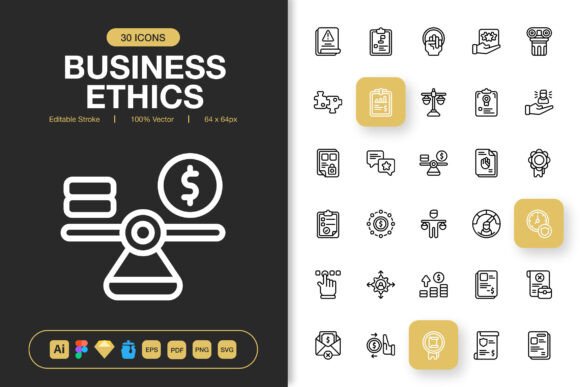
When seeking visual assets for professional communications, icon sets designed around specific themes can offer significant utility. The Business Ethics Icons collection is a set of high-quality icons centered on concepts related to ethical business practices, corporate responsibility, and integrity. It is presented as a versatile toolkit suitable for a wide range of applications, from digital interfaces to print materials.
Understanding the Business Ethics Icons Collection
This collection is fundamentally a curated library of minimalist icon designs. The theme focuses on symbols representing transparency, fairness, sustainability, compliance, and related ethical principles. The core offering is not just the thematic imagery but the breadth of included file formats and practical features. Key advertised features include editable stroke paths, multiple high-resolution PNG sizes, and source files in formats like Adobe Illustrator, Figma, Sketch, EPS, SVG, and PDF. This multi-format approach aims to provide flexibility for designers and content creators working across different software ecosystems.
Potential Reasons for Interest
Individuals or teams researching such a product are often motivated by specific project needs. A primary reason could be the requirement for a coherent visual language to communicate complex ethical principles simply and effectively. This is common in corporate sustainability reports, internal training materials, compliance documentation, or public-facing social responsibility campaigns. The thematic focus eliminates the need to piece together disparate symbols from generic packs, potentially saving time and ensuring visual consistency.
Another strong motivator is the need for technical flexibility. Projects often span multiple platforms—a website, a mobile app companion, and printed flyers. Having access to the same icon set in vector formats (like SVG and EPS) for scalable digital use and in rasterized PNGs at specific sizes for precise implementation can streamline workflow. The inclusion of files for popular design tools like Figma, Sketch, and Illustrator caters directly to professionals embedded in those platforms, reducing conversion steps.
Key Benefits and Practical Value
The principal benefit of a collection like Business Ethics Icons is its thematic specialization. For projects where ethical messaging is central, using icons that directly symbolize trust, balance, green initiatives, or diversity can enhance comprehension and reinforce brand values. The minimalist design style also aligns with contemporary design trends, favoring clarity and reducing visual clutter across interfaces.
From a production standpoint, the bundle of file formats addresses a common pain point: asset adaptation. Instead of manually resizing or recreating icons for different mediums, having pre-set PNG sizes (from 32px to 512px) and scalable vectors can expedite deployment. The editable stroke feature is a significant consideration for customization; it allows designers to adjust line weight, color, and minor details to better match an existing brand’s style guide without starting from scratch.
Tradeoffs and Important Considerations
While the features are comprehensive, potential users must weigh them against their specific context. The first consideration is scope. The set is fixed around business ethics concepts. If a project requires a broader range of icons covering general commerce, finance, or unrelated topics, this collection alone may be insufficient. It might serve as a thematic supplement to a larger, more generic icon library.
A second consideration is skill requirement. Although files are provided for major applications, fully leveraging the editable vector source files requires proficiency in those tools (e.g., Illustrator or Sketch). Teams without dedicated design expertise might rely more on the PNG files, which are easier to use but offer less flexibility for customization. The value of the package is thus tied to the technical capabilities of the user.
Finally, the minimalist design approach, while clean, may not suit every brand aesthetic. Projects requiring highly detailed, illustrative, or textured icons might find this style too austere. Evaluating the existing visual identity is crucial to determine if these icons would integrate harmoniously.
Situations Where This Collection is a Strong Fit
This icon set aligns well with several clear scenarios. Organizations developing dedicated ethics or compliance training modules, either internally or for clients, would find the symbols directly relevant. Non-profits or advocacy groups focusing on corporate accountability could use these icons in infographics, posters, and social media campaigns to visually underscore their messaging.
It is also a strong fit for integrated cross-media projects. A company launching a sustainability initiative might need icons for a webpage, a PDF whitepaper, presentation slides, and promotional banners. The multi-format nature of Business Ethics Icons facilitates this consistent application across all channels. For design teams already using Figma, Sketch, or Illustrator as their primary tools, the inclusion of native source files minimizes friction in the asset preparation phase.
When Alternatives Might Be Worth Considering
Alternatives should be explored in certain situations. If the project budget is limited and the need for ethics-themed icons is minor, exploring free or open-source icon libraries with a few relevant symbols might be more economical. Some comprehensive general icon sets also include sections on ethics or sustainability, which could provide a wider range of imagery for future projects.
For projects requiring extreme stylistic customization beyond simple color or stroke adjustment—such as complete shape alteration or integration of complex textures—starting from a more basic or foundational vector set, or even custom illustration, might be a better path. Similarly, if the technical workflow is heavily centered on a tool not included (like a specific prototyping software), verifying the compatibility of the provided SVG or PNG files with that tool is essential before commitment.
Practical Decision-Making Insights
To determine if Business Ethics Icons aligns with your goals, conduct a simple asset audit. List all the visual symbols required for your current project. How many fall squarely under the ethics theme? Next, review your production pipeline. Which software does your team use most? Check if the provided file formats match. Also, consider future needs; will you likely revisit ethical themes in upcoming projects, making this a reusable asset?
Evaluate the importance of customization. If matching your brand’s exact icon style is non-negotiable, prioritize the editable vector files. Test a sample if available, to see if the level of customization offered meets your standard. Conversely, if you only need standard icons quickly, the PNG files may suffice.
Ultimately, the decision hinges on the intersection of thematic relevance, technical compatibility, and design flexibility. The Business Ethics Icons collection presents a focused solution that can significantly enhance projects where its specific theme and format strengths are fully utilized. By objectively assessing your project's demands against these offerings, you can make an informed choice about incorporating this set into your visual toolkit.