The Unassuming Power of Outline Icons in Visual Communication
In the landscape of digital and print design, clarity and simplicity often win. While detailed, colorful illustrations have their place, there is a growing recognition of the utility and elegance of minimalist iconography. Among various styles, outline icons represent a particularly versatile tool. Their clean lines and uncluttered forms offer a directness that can enhance comprehension and aesthetic cohesion across a multitude of projects.
From Kindergarten Walls to Professional Projects
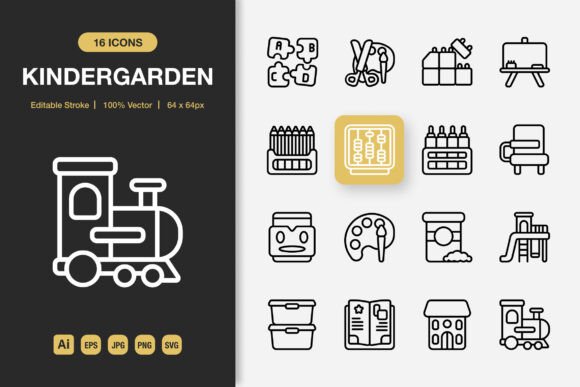
The concept of simple outline drawings is familiar from early childhood. Think of the basic shapes and friendly figures used in kindergarten materials to teach concepts. These Kindergarden Outline Icons, in their purest form, communicate without ambiguity. This foundational principle of visual communication—that a clear outline can effectively denote an object, action, or idea—translates powerfully into professional creative work. Modern sets of high-quality outline icons are the sophisticated evolution of that childhood simplicity, crafted with precision for contemporary needs.
Core Characteristics of Modern Outline Icon Sets
A well-designed set of outline icons is defined by several key characteristics. First is Editable Stroke. This technical feature means the lines composing the icons are not fixed pixels but adjustable paths, allowing designers to change stroke weight, making the icons bolder or more delicate to match a project’s tone. Second is High Quality, ensuring clean vectors without jagged edges, scalable to any size without loss of detail. A collection often boasts being 100 Customizable, providing not just quantity but the freedom to alter colors, combine elements, or adjust shapes within a cohesive style. The Easy Drag and Drop nature speaks to user experience, integrating seamlessly into design workflows without complex steps.
The practical value is cemented by the Files Included. A comprehensive package typically provides multiple formats: a Source File Adobe Illustrator for deep editing, an EPS Version 10 for compatibility with various vector programs, a JPG File for standard raster use, a SVG File for web and modern applications where scalability is key, PNG Transparency for easy overlaying on any background, and a simple Readme.txt to guide usage. This multi-format approach removes technical barriers, making the assets accessible to users with different software expertise.
The Broad Spectrum of Application
The true test of a design resource is its adaptability. Minimalist icon design proves its worth by fitting effortlessly into diverse contexts. For websites, they serve as intuitive navigation aids, loading quickly and maintaining clarity on various screen sizes. In mobile apps, their simplicity reduces visual clutter on smaller interfaces, improving user focus. Authors and publishers use them in books and e-books to visually punctuate chapters or illustrate concepts without the distraction of full-color graphics.
On social media, these icons can create consistent branding in posts, infographics, and profile elements. They are, indeed, perfect for infographics where the goal is to convey data and relationships clearly; outline icons don’t compete with charts and text. For printed materials like flyers, print documents, banners, and posters, they offer crisp reproduction at any scale, from a business card to a large format print. This same set might be used in presentation slides, instructional manuals, product packaging, and signage. The list extends to and many more precisely because the style is fundamentally neutral and communicative.
Advantages of Embracing Minimalism in Iconography
Choosing a minimalist icon design over more ornate styles brings several concrete advantages. Visually, it creates a sense of order and space. It directs the user’s attention to content and functionality rather than decorative elements. From a brand perspective, a clean icon set can convey modernity, professionalism, and clarity. It also offers greater longevity; minimalist trends are less susceptible to rapid shifts in fashion than highly stylized graphics.
There are practical performance benefits too. SVG and PNG files with transparent backgrounds are typically lightweight, contributing to faster website load times and smoother app performance. The customizable nature means a single set can be adapted to color schemes for different campaigns or seasons, ensuring visual consistency without requiring new asset purchases. For teams, using a unified icon set across different projects—a website, an app, and printed brochures—creates a strong, recognizable identity.
Changing Your Next Projects
Incorporating a high-quality outline icon set can fundamentally alter a project’s development. It shifts the early design phase from potentially searching for disparate visual elements to working with a coherent library. This accelerates mockup and prototype creation. The editable nature allows for on-the-fine-tuning: if an icon needs to be slightly thicker to match a font weight, or a color changed to meet accessibility standards, it can be done quickly without starting from scratch. The drag-and-drop functionality further streamlines the process, making it accessible even to those with less advanced design software skills.
Consider an educator creating digital learning materials. Using a consistent set of outline icons for different subjects—a simple outline of a book for literature, a flask for science, a globe for geography—helps students quickly identify content sections. A small business owner designing a flyer can use outline icons of a phone, email envelope, and map pin to contact information clearly and professionally without needing a graphic designer. A researcher preparing a conference poster can use minimalist icons to denote methodology sections, results, and references, making the complex information more navigable.
Key Considerations When Selecting and Using Icon Sets
While the benefits are significant, successful use depends on thoughtful selection and application. Not all outline icon sets are created equal. Assessing the High Quality claim is crucial; previewing icons at large sizes can reveal poor line work or inconsistent proportions. The range of symbols in a 100 Customizable set should be evaluated for relevance to your field—does it include the specific metaphors you need? Check the actual Files Included to ensure you have the formats required for your primary tools.
In application, consistency is paramount. Using icons from the same family throughout a project maintains visual harmony. Overuse should be avoided; icons should aid communication, not become visual noise. It’s also important to consider cultural context; some outline symbols may have different connotations in different regions. Accessibility is another vital factor. Icons should be used to reinforce, not replace, clear text labels, and their contrast against backgrounds should meet guidelines for visually impaired users.
Real-World Integration and Workflow
The journey from acquiring an icon set to final implementation illustrates its value. A designer might start in Adobe Illustrator, using the source file to tweak a few icons to perfectly match a client’s brand guidelines, perhaps adjusting the stroke or merging two simple shapes to create a custom symbol. For web implementation, the SVG File versions are placed into the code, allowing for dynamic color changes via CSS to match different site states—like a hover effect. For a quick social media graphic, the designer might simply drag a PNG Transparency file into a template, positioning it effortlessly over a colored background.
The inclusion of a Readme.txt file often provides this crucial bridge, offering basic instructions on file types, licensing, and best practices. This small document helps hobbyists, business owners, and professionals alike to use the assets correctly, ensuring they get the full benefit without technical missteps. The result is a project that feels polished and unified, where the visual elements work quietly but effectively to support the core message or function.
The evolution from the simple outlines used to teach children to the sophisticated, editable sets used in professional environments is a story of refined utility. It highlights that effective communication doesn’t always require complexity. In a world saturated with visual information, the clear line, the open shape, the minimalist form can cut through the noise, providing guidance, enhancing understanding, and contributing to a clean, purposeful design. Whether for a global website, a community flyer, or a personal blog project, these icons offer a foundation of visual clarity that can adapt to nearly any creative need.