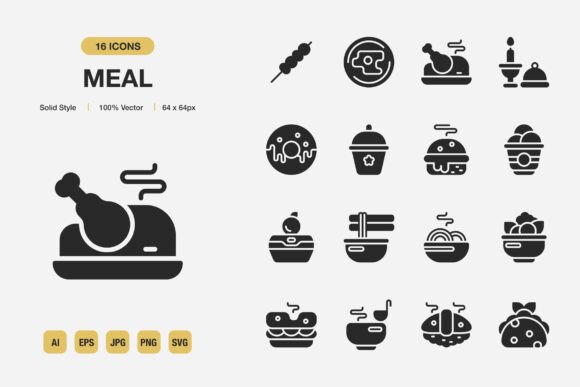
Meal Solid Icons: The Power of Simplicity in Your Projects
In the world of design, clarity often trumps complexity. Whether you’re building a website, launching an app, or creating a flyer, the visual symbols you use—your icons—communicate instantly. Meal Solid Icons is a set of high-quality icons designed with this principle at its core: a minimalist, solid style that is suitable for any project. The promise is enticing: a versatile toolkit to change your next project. But as with any tool, its value is realized not just in possession, but in understanding and skillful application.
The Common Misconception: An Icon Set is Just a Download
A common oversight is treating a premium icon set like a simple download. You acquire the files, drop them in, and consider the job done. This approach overlooks the strategic role icons play. Icons are not decorative elements; they are functional guides. They direct user attention, explain features without text, and establish a visual tone. When you choose a set like Meal Solid Icons, you’re investing in a visual language for your project. The mistake here is underutilization. Using these clean, solid icons haphazardly, without considering consistency and context, dilutes their power and can leave your design feeling disjointed.
The effect is a presentation that fails to communicate cohesively. Users might find your interface confusing or your print material visually cluttered, despite using "minimalist" icons. The better approach is to plan your icon usage before you even start dragging and dropping. Define a small, consistent subset from the Meal Solid Icons library that will serve your project’s specific needs—perhaps 20 core icons for navigation and key actions. This creates a recognizable pattern, enhancing usability and professional polish.
Overlooking File Format Versatility: The Source Matters
The inclusion of multiple file formats—Adobe Illustrator source files, EPS, SVG, PNG, and JPG—is a significant feature of Meal Solid Icons, yet it’s frequently taken for granted. Beginners might gravitate immediately to the PNG files for their ease, while professionals might only glance at the SVG. Each format serves a distinct purpose in different mediums, and ignoring this range limits your efficiency and future flexibility.
For instance, using a PNG on a website when an SVG is available means losing scalability and crispness on high-resolution displays. Conversely, using an EPS file for a quick social media graphic adds unnecessary complexity. The practical advice is to match the format to the medium. Use the SVG files for web and app development where scalability and performance are key. Use the PNG with transparency for direct placement in digital banners or simple print work. And always keep the Adobe Illustrator source file safeguarded; it is your master key for any future customization, allowing you to tweak colors or combine elements uniquely for your brand without degrading quality.
The "Customizable" Trap: Assuming Changes Are Simple
The feature "100 Customizable" is appealing, but it can lead to a misunderstanding. "Customizable" does not mean "editable with zero design skill." It means the icons are provided in a vector source format (like the Illustrator file) that enables customization. A mistake is to assume you can radically alter these icons in five minutes with any software. Attempting to edit the EPS file in a basic image editor will result in frustration and quality loss.
This affects your project’s cost and timeline if you lack the appropriate software or fundamental vector editing skills. Before purchase, honestly assess your toolkit and ability. Do you have access to Adobe Illustrator or a compatible vector program? If not, you can still use Meal Solid Icons powerfully in their provided states, but your customization scope will be limited to choosing from the included PNG or SVG sizes. The better approach is to either partner with a designer for customization or focus on leveraging the icons’ inherent solid-style aesthetic, which is designed to be impactful without modification.
Quality Beyond First Glance: Checking the Details
High quality is stated, but you must verify it in context. A common error is evaluating icon quality only by viewing the preview image. True quality lies in the execution across all file formats and the consistency of the design set. After downloading Meal Solid Icons, open several files. Check that the SVG code is clean and not overly complex. Verify that the PNG transparency is perfect, with no residual white edges. Examine the Illustrator source file to ensure icons are neatly grouped and layers are organized.
Poor file construction can lead to hours of cleanup work, hindering your efficiency. A professional, high-quality set like Meal Solid Icons should have these details meticulously handled, allowing you to focus on implementation. Your pre-use check should be a quick audit of the delivered files. Open the readme.txt, explore the different format folders, and test one icon in your intended application environment. This five-minute safeguard prevents project delays.
The Drag-and-Drop Pitfall: Mindless Placement
The "Easy Drag and Drop" convenience is a benefit, but it can encourage a thoughtless workflow. Icons are placed where space is empty, not where user need is greatest. This mistake impacts communication and satisfaction. For example, placing a solid-style food icon for a "menu" button is logical, but using a complex solid icon for a "settings" function might be less intuitive than a simpler gear outline.
To avoid this, use the Meal Solid Icons set as a curated library, not a random grab-bag. Before dragging any icon, ask: "What action or concept does this represent? Is this the clearest symbol for my audience?" Often, the minimalist nature of solid icons means they excel at representing concrete objects (like a meal, a phone, a location) but might require user testing for more abstract concepts. Pair your icon placement with brief text labels if clarity is uncertain, especially in critical navigation areas.
Ensuring Suitability for "Any Project": The Reality Check
The claim "suitable for any project" is broadly true given the icon style and format range, but a prudent creator evaluates specific suitability. A mistake is forcing an icon style onto a project with an incompatible established aesthetic. While Meal Solid Icons' minimalist solid design is versatile, it might not seamlessly integrate into a project already using highly detailed, line-based illustrations.
The effect could be a visually conflicting final product. Before committing, do a quick style audit. Do the solid icons complement your project’s existing fonts, color palette, and imagery? Create a mockup with a few key Meal Solid Icons placed alongside your other elements. This real-world test gives you confidence that the set will enhance, not fight, your overall design. Remember, suitability is about harmony, not just availability.
In conclusion, Meal Solid Icons presents a robust opportunity to elevate your work across websites, apps, print media, and more. Its strength lies in its simplicity, quality, and comprehensive file support. By avoiding the common pitfalls of mindless placement, format neglect, and misunderstood customization, you can harness this set to its full potential. Approach it as a strategic visual asset. Plan its use, respect the technical details, and align it with your project’s voice. When used thoughtfully, these minimalist icons become not just graphics, but a clear, compelling language for your ideas.