Electronic Component Icons: A Designer's Swiss Army Knife for Modern Projects
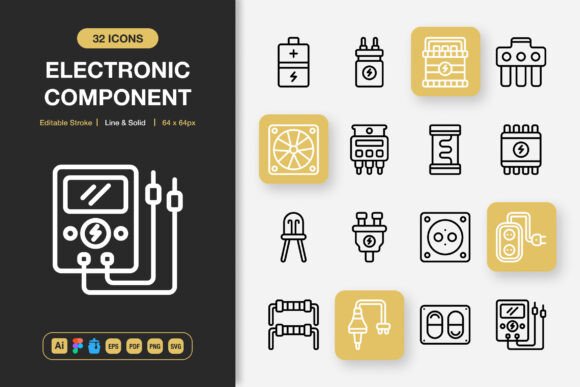
The visual language of technology is built on symbols. From a simple resistor schematic in a textbook to the intricate circuit diagrams in a professional engineering software suite, icons representing electronic components form a fundamental shorthand. This specialized visual vocabulary is now a crucial asset far beyond its traditional technical confines. A comprehensive set of high-quality electronic component icons serves as a versatile toolkit for creators across a stunning range of disciplines. Whether you're annotating a user manual, designing a tech-themed website, or creating educational material for a microcontroller course, having a cohesive, minimalist icon library at your fingertips can fundamentally change the efficiency and polish of your next project.
Where Icon Libraries Fit Into The Creative Process
Integrating a professional icon set into your workflow isn't an afterthought; it’s a strategic decision that impacts every phase of a project. During the initial planning and wireframing stage for a website or mobile app focused on electronics, hardware, or STEM education, you can immediately place placeholder icons from the set into your mockups. This allows you to establish a visual hierarchy and user experience based on actual assets from the start, rather than generic boxes. It prevents the common workflow disruption of designing a layout only to later discover your icon assets don’t fit the spatial or stylistic constraints you’ve already established.
For ongoing tasks like maintaining a blog on DIY electronics or producing regular social media content for a tech brand, the library becomes an organizational anchor. Instead of scouring the web for a different, potentially mismatched icon for each new post or infographic, you pull from your curated, consistent collection. This ensures brand and thematic consistency over time, a key factor in building recognizable and trustworthy visual communication. The efficiency gain here is tangible: less time searching, less time adjusting, more time creating.
Interoperability With Tools and Teams
A robust icon set’s value is multiplied by its compatibility with the software and platforms you already use. Consider the practical implications of receiving files in multiple formats. The Adobe Illustrator source file allows senior designers or brand managers to make deep, structural modifications to the icons—adjusting stroke weights, merging shapes, or extracting specific elements for custom logo work. The Figma file enables real-time collaborative prototyping and design within teams, where icons can be instantly shared and used across different pages and frames.
For developers or web designers focused on implementation, the SVG files are indispensable. Scalable Vector Graphics integrate directly into code, ensuring icons render crisply at any size, from a tiny favicon to a large poster, without multiple image files. The provided PNGs at specific pixel sizes (32px to 512px) are perfectly suited for rapid deployment in environments where vector support might be limited, such as certain email clients, legacy publishing software, or specific social media platforms that favor predefined image dimensions. The inclusion of an IconJar file speaks directly to workflow organization on the designer’s desktop, allowing for quick search and drag-and-drop from a dedicated management app into their current design software.
Practical Implementation Across Diverse Media
The true test of any asset library is its application in real-world scenarios. Let’s explore how electronic component icons can be woven into specific projects.
For a website selling electronic kits, icons can be used not just as decorative elements, but as functional navigation aids. A capacitor icon could label the “Capacitors” product category page, while a transistor icon might signify “Semiconductors.” This creates an intuitive, theme-relevant user interface. In a mobile app for circuit simulation, these icons form the core interactive elements users drag and drop to build their schematics, requiring clarity and immediate recognition at small sizes.
In print and educational materials, such as books, flyers, or posters for a university engineering department, the high-quality line and solid styles offer flexibility. The line style, with its editable stroke, might be perfect for detailed textbook diagrams where precision is key. The solid, filled style could be used for bold posters and banners where visual impact from a distance is necessary. The consistent design across all icons ensures that whether a student sees a diode icon in a lecture slide (PNG 256px), a printed handout (from the PDF), or an online supplement (SVG), they recognize the same symbol.
Content creators and marketers can leverage these icons to elevate their infographics explaining tech trends or video thumbnails for tutorial series. The minimalist design ensures the icons don’t clutter complex information but rather enhance and clarify it. A blogger writing a comparison of microcontrollers can use consistent icons for ports, pins, and power inputs across all their articles, making their entire body of work feel more professional and authoritative.
Managing Quality and Long-Term Use
Adopting a comprehensive set like this is also an investment in future projects. The 100 customizable icons provide a broad base, covering common components from resistors and LEDs to more specialized symbols. This breadth means you’re less likely to need to supplement the set for niche projects, maintaining stylistic purity. The editable nature of the core vector files (AI, EPS, SVG) is critical for long-term use. As your brand evolves or a specific project requires a slight tweak—like changing the stroke color to match a new brand palette—you can do so without losing quality or starting from scratch.
Organization is another subtle benefit. Having all assets—from source vectors to ready-to-use PNGs—in one package, accompanied by a straightforward readme file, eliminates the digital clutter of sourcing from multiple websites or dealing with inconsistent licenses. It creates a single, reliable reference point in your digital asset library. For freelancers and small business owners, this saves administrative time and reduces the risk of using an unlicensed or low-quality asset in a client project.
Streamlining Workflow From Concept to Delivery
Imagine the workflow for creating a new feature announcement for a hardware product. The marketing team starts in Figma, using the icons from the shared file to layout the key features visually in the prototype. The graphic designer then takes the approved layout, opens the Illustrator file to make final color adjustments matching the new campaign, and exports the high-resolution PDFs for the print flyer and the SVGs for the web page. The web developer receives the SVGs and integrates them directly into the codebase. Meanwhile, the social media manager uses the pre-sized 512px PNGs to create engaging posts. Every team member is working from the same visual foundation, ensuring absolute consistency across all touchpoints, without any asset conversion or quality degradation steps.
This seamless interoperability reduces friction, minimizes revision cycles caused by mismatched assets, and accelerates the overall project timeline. It turns a potentially fragmented process into a cohesive, parallel workflow where design and implementation can progress in lockstep.
Ultimately, a well-crafted set of electronic component icons transcends its nominal category. It becomes a fundamental pillar for clear visual communication in technology-related fields. By providing quality, flexibility, and wide compatibility, it empowers professionals, educators, and creators to execute their projects with greater confidence, efficiency, and visual cohesion. It allows you to focus on the core message or function of your project, knowing that the illustrative elements are handled by a reliable, scalable, and professional toolkit that fits as neatly into your process as a well-designed component fits into a circuit board.